

Kissei Basic Policy on Corporate Governance
Kissei Basic Policy on Corporate Governance
1. Basic Approach
● Kissei Pharmaceutical Co., Ltd. (“we,” “our,” “the Company”) positions the enhancement and strengthening of corporate governance as an important management issue in fulfilling our corporate social responsibility. Our aims are to enhance corporate value, achieve continuous growth as a corporation with social significance and value, and maintain good relationships with our shareholders, investors, customers, local communities, business partners, employees, and other stakeholders.
● This Basic Policy sets forth our basic framework for corporate governance. It is continuously and regularly reviewed by our Board of Directors to enhance corporate value.
2. Our Corporate Philosophy and Management Vision
● We engage in business activities under our Corporate Philosophy of contributing to society through high-quality, well-evidenced pharmaceutical products and serving society through our people, as well as our Management Vision of becoming a drug discovery and R&D-oriented pharmaceutical company that helps improve people’s health worldwide by developing and supplying innovative products.
3. Legal Compliance and Conduct Rules
● Our basic policy is to comply with all applicable laws, regulations, and social norms in all aspects of our business activities and to ensure our conduct is based on high ethical standards. As rules of conduct to achieve this purpose, we have established the Kissei Code of Conduct, based on our Corporate Philosophy and Management Vision. The Code of Conduct applies to all our officers and employees.
● We have established a Compliance Committee to promote compliance with laws and regulations. We are working to raise the awareness of all officers and employees and to build an effective structure through in-house education and the establishment of a whistleblowing system.
4. Diversity of Talent Utilization
● In the Kissei Code of Conduct, we have articulated that we respect the diversity, character, and individuality of our employees and strive to enhance their ethical awareness while also cultivating their personal development as one of the rules.
● As part of our efforts to create a structure for embracing diverse values, we are making improvements to the working environment, such as employment formats, work styles, and personnel treatment systems, to ensure that diverse human resources can demonstrate their abilities.
5. Appropriate Information Disclosure
● We disclose financial information including our financial position and business performance and non-financial information such as information on management strategies, management issues, risks, and governance in an appropriate manner in accordance with laws and regulations. We are also working to proactively provide information other than that subject to disclosure under laws and regulations.
6. Profit Distribution
● We give top priority to investment to achieve growth and remain mindful of maintaining stable dividends. At the same time, we strive to enhance corporate value while maintaining a balance between investment and shareholder returns. We pay a progressive dividend (ordinary dividend) and aim for a dividend payout ratio of 40% or more.
● As a basic policy, we pay dividends of surplus twice a year: an interim dividend and a year-end dividend. Interim dividends are determined by the Board of Directors and year-end dividends by the General Meeting of Shareholders. In addition, our Articles of Incorporation provide that the Company may, by resolution of the Board of Directors, pay interim dividends with a record date of September 30.
● We repurchase shares and dispose and cancel treasury stock flexibly based on resolutions of the Board of Directors, according to the status of business development, with increasing shareholder value as our primary objective.
● We actively invest internal reserves in the research and development of pharmaceuticals sought by patients, while responding to administrative and institutional changes and the progress of globalization that are expected in the future. We believe that this will contribute to future profits and to the appropriate distribution of profits to shareholders.
7. General Meeting of Shareholders
● We recognize that the General Meeting of Shareholders is a forum for constructive dialogue with shareholders. Our basic stance is to ask shareholders to approve proposals at the General Meeting of Shareholders after thoroughly explaining them and fielding their questions on such topics as the status of our business and the issues we need to address.
● For shareholders to fully consider the proposals for the General Meeting of Shareholders, we send out the Notice of Convocation of the General Meeting of Shareholders before the legal deadline to ensure sufficient time for consideration. In addition, we disclose the contents of the Notice of Convocation on our website prior to the dispatch date.
● We set the date, time, and venue of the General Meeting of Shareholders so that as many shareholders as possible can attend, while also considering cost effectiveness.
● We provide shareholders with the opportunity to exercise their voting rights via the internet and through other means. We also participate in the Electronic Voting Platform to provide opportunities for institutional investors, etc. to smoothly exercise their voting rights.
● If institutional investors, etc. who hold shares in the name of trust banks, etc. wish to exercise their voting rights at the General Meeting of Shareholders, we coordinate with beneficial shareholders and nominee shareholders in advance and determine whether or not they may attend the General Meeting of Shareholders.
8. Securing of Shareholders’ Rights
● We have developed an environment that allows shareholders to exercise their rights appropriately.
● The securing of shareholders’ voting rights is described in “7. General Meeting of Shareholders.”
● If it is determined that, even though a proposal we make at the General Meeting of Shareholders was passed, a significant number of votes had been cast against it, the Board of Directors will analyze the causes of the large number of votes cast against the proposal and consider the results of that analysis to reflect them in management policies.
● Before submitting to the General Meeting of Shareholders a proposal to delegate certain matters for resolution at the General Meeting of Shareholders to the Board of Directors, the Board of Directors will sincerely discuss whether the Company has an appropriate system that justifies making the proposal.
● We give due consideration to the exercise of the rights granted to minority shareholders by ensuring the equality of shareholders and giving consideration to minority shareholders.
9. Dialogue with Shareholders
● The Public Relations Department is in charge of dialogue with shareholders. It handles this duty appropriately in cooperation with the president and representative director (COO), directors in charge, departments in charge, and others.
● Regarding the disclosure and explanation of financial results information, etc., departments including those responsible for corporate strategy and planning, accounting, and general administration hold regular meetings with the Public Relations Department to exchange opinions based on their respective professional perspectives to support dialogue with shareholders.
● Through financial results briefings and information disclosures on our website, we are working to deepen shareholders’ understanding of our management strategies and business environment. The opinions received through such activities and dialogues with shareholders are shared at Board of Directors meetings as appropriate and used for the review of our management policies and in other ways.
● For dialogues with shareholders, we have established the Kissei Information Disclosure Policy and, in accordance with laws and regulations and internal rules, we pay due attention to the handling of insider information while taking care not to cause disparities among shareholders in the disclosure of material facts.
● Regarding the shareholder structure at the end of the fiscal year and at the end of the interim period, we collect the necessary information from the shareholder register prepared by a stock transfer agency, and we conduct a beneficial shareholder survey once a year in principle, in an effort to understand the shareholder structure.
10. Roles, etc. of the Board of Directors
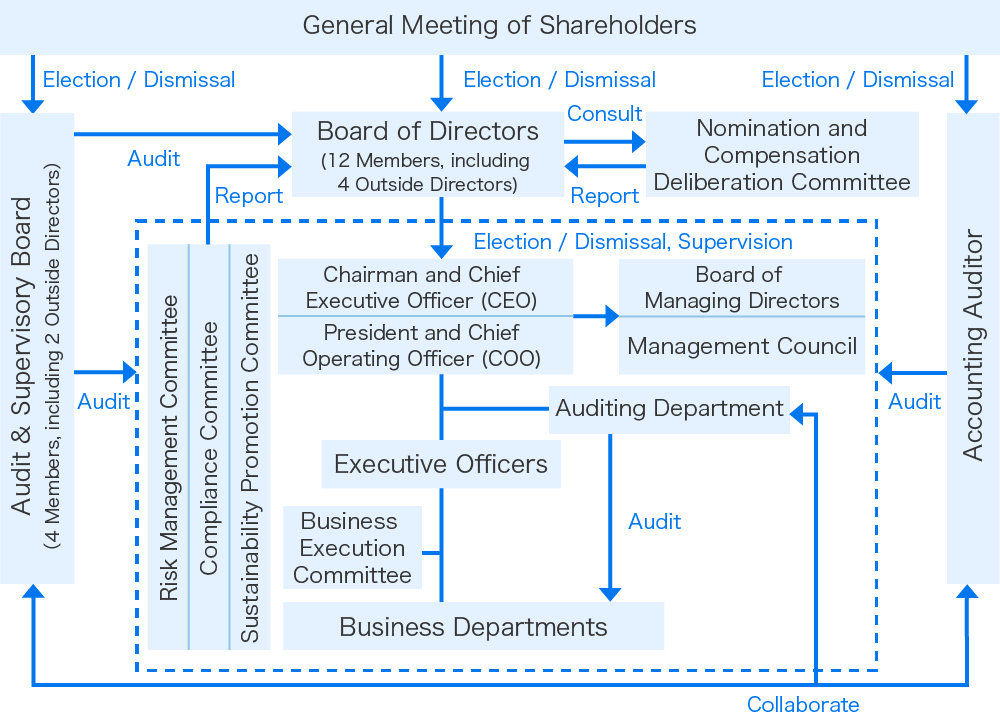
● For our corporate governance structure, we have adopted the structure of a company with an Audit & Supervisory Board. In addition, we believe that it is reasonable to further strengthen the functions of the Board of Directors by appointing outside directors, while also strengthening the Audit & Supervisory Board Members’ functions, to further enhance their management monitoring function.
● We position the Board of Directors as the body responsible for making decisions on basic management policies and important management matters, as well as the body responsible for supervising the execution of business operations, and we are working to speed up decision-making and improve management transparency.
● In the execution of operations entrusted by the Board of Directors, the chairman and chief executive officer (CEO) supervises overall management, and the president and chief operating officer (COO) is responsible for overall business execution, in order to further strengthen the management structure, enhance agility, and further strengthen management capabilities. We have also established the Business Execution Committee as an advisory body to the COO to assist the COO in making decisions and in considering management issues to be proposed and reported to the Board of Directors.
● To make the execution of duties by directors more efficient, we have created internal organizations with the intention of cooperation and checks-and-balances. We have also established clear segregation of duties, job authorities, and decision-making procedures in accordance with internal regulations. This ensures that we have a system for directors to execute their duties appropriately and efficiently. Matters including those of importance such as those stipulated by laws and regulations and the Articles of Incorporation, matters related to the Company’s organization and structure, acquisition and disposal of significant assets, important personnel matters, and matters related to officers are matters to be resolved by the Board of Directors. As a general rule, individual business execution is performed by the president and chief operating officer (COO), directors who are also in charge of business execution, executive officers, division heads, and others. The segregation of duties and classification of job authorities are clearly defined in our internal rules.
● The Articles of Incorporation stipulate that the number of members of the Board of Directors will not exceed 14 (including outside directors).
● Each director conducts a self-evaluation of the Board of Directors once a year. Opinions from each director are collected and discussed among the outside directors, the chairman and chief executive officer (CEO), the president and chief operating officer (COO), and other directors, and used to enhance corporate governance.
● As a general rule, materials used at meetings of the Board of Directors are sent to each director and each Audit & Supervisory Board member no later than three business days prior to the date of the meeting. In addition, when necessary, the secretariat of the Board of Directors provides individual explanations to outside directors and outside Audit & Supervisory Board members on the content of proposals and the Company’s business conditions behind the proposals. Through such prior explanations, we strive to promote understanding among outside directors and outside Audit & Supervisory Board members and to stimulate discussions at the Board of Directors meetings.
● The schedule for meetings of the Board of Directors is determined semi-annually and notified to the members of the Board of Directors in advance. In addition, extraordinary meetings of the Board of Directors are held as necessary to facilitate swift and agile decision-making.
● So that the directors and Audit & Supervisory Board members may fulfill their expected roles and responsibilities appropriately, we provide external training opportunities to newly appointed directors and Audit & Supervisory Board members upon their appointment. We also provide or arrange for training that is suitable for each director and each Audit & Supervisory Board member, as well as provide financial support for such training. Our directors and Audit & Supervisory Board members also strive to acquire the knowledge necessary for the performance of their duties as directors and Audit & Supervisory Board members. Their methods include sharing information on the activities of each division, the latest industry trends, pharmaceutical regulations, and other matters through participation in twice-yearly meetings of all division heads and above.
11. Nomination and Compensation, etc. of Directors
● We have established a Nomination and Compensation Deliberation Committee. The Nomination and Compensation Deliberation Committee consists of the outside directors (including outside Audit & Supervisory Board members in cases where outside directors are appointed Audit & Supervisory Board members), the chairman and chief executive officer (CEO), and the president and chief operating officer (COO).
● The Nomination and Compensation Deliberation Committee deliberates on candidates for appointment and dismissal of officers and makes proposals to the Board of Directors. In addition, the Committee deliberates on the level and other aspects of compensation for directors and makes proposals to the Board of Directors.
● The Nomination and Compensation Deliberation Committee takes into account the following factors when considering candidates for election and dismissal of directors.
1. Qualifications of directors: Persons who are capable of contributing to the continuous growth of the Company and the enhancement of corporate value in the execution of their duties, regardless of gender
2. Qualifications of executive directors: Persons who excel in the execution of their primary duties, enabling the Company to efficiently conduct the prescription drug business, and who are capable of fulfilling the mandate of shareholders
3. Qualifications of independent outside directors: Persons who are able to provide supervision and advice from an independent standpoint based on their abundant knowledge, even if they are not necessarily familiar with the prescription drug business
● The Board of Directors nominates candidates for appointment and dismissal of officers based on their experience and knowledge and on evaluation of their performance. It explains the reasons for appointment and dismissal of the candidates in the Notice of Convocation of the General Meeting of Shareholders.
● The policy regarding the determination of compensation, etc. for directors is disclosed in the Corporate Governance Report and the Annual Securities Report. We believe that the current compensation structure helps to provide sound motivation.
12. Outside Officers (Outside Directors and Outside Audit & Supervisory Board Members) and Independent Outside Directors
● We believe that the appointment of independent outside directors with diverse expertise and experience will further stimulate discussions at the Board of Directors meetings and ensure appropriate decision-making and oversight. Accordingly, if there are suitable candidates with experience and knowledge that will contribute to the enhancement of the Company’s corporate governance, we intend to appoint them as independent outside directors.
● The status of concurrent positions held by outside officers at other companies is disclosed annually through Notices of Convocation of the General Meeting of Shareholders, Annual Securities Reports, Corporate Governance Reports, and other disclosures. If an outside officer concurrently serves as a director or other officer of another company, we believe that they should hold a moderate number of such positions to ensure that they are able to devote the time and effort required to perform their roles and responsibilities as director or Audit & Supervisory Board member of the Company appropriately.
● To ensure that outside officers can duly fulfill their functions, we provide training and other opportunities tailored to individual outside officers so that they can acquire the necessary knowledge regarding our business, finance, organization, and other matters upon assuming office and on an ongoing basis after assuming office.
● Based on the independence criteria established by securities exchanges, we consider an outside officer to be independent if he or she does not fall under any of the following conditions.
-
1. Current and former executive (Note 1) in the Kissei Group
-
2. Executive of the following corporations or other entities currently and during the past three years:
- ① A corporation or other entity whose major business partner (Note 2) is the Kissei Group, or a corporation or other entity that is a major business partner (Note 2) of the Kissei Group
- ② Consultants, accounting professionals such as certified public accountants, or legal professionals who have received a large amount of money or other property (Note 3) from the Kissei Group in addition to their officer compensation (In cases where the party that has received said property is a corporation or other entity, this means a person who belongs to said entity)
- ③ Audit firms that have been Kissei Group’s accounting auditor during the past three fiscal years to the present
- ④ A person who has received a donation in the form of a large amount of money or other property from the Kissei Group, or a corporation or other entity that has received such a contribution
- ⑤ A corporation or other entity that is a current major shareholder (Note 4) of Kissei Pharmaceutical or a company of which Kissei Pharmaceutical is a current major shareholder
- ⑥ A listed company in a relationship of mutual appointment of outside officers with the Kissei Group
-
3. A relative within the second degree of kinship of the executive set forth above
- Notes: 1. Executive refers to an executive director of a stock company, an executive officer or other officer who executes the business of a corporation, etc., a company member who executes the business, or, in cases where a corporation is the member who executes the business, a person who is to perform the duties of the member who executes the business and a person equivalent to that, as well as an employee of the corporation.
- 2. Major business partner refers to an entity whose transactions with the Kissei Group as consideration for products or services amounted to over 2% of the consolidated net sales of the entity and of the Kissei Group in any one of the past three fiscal years. It also refers to lenders from which the Kissei Group has procured funds exceeding 2% of the Company’s consolidated total assets at the end of any of the past three fiscal years.
- 3. A large amount of money or other property refers to an amount of 10 million yen or more paid by the Kissei Group to an individual, or, in the case of a corporation or other organization, an amount of payment exceeding 2% of the organization’s total revenue, both in any of the past three fiscal years.
- 4. Major shareholder refers to a shareholder who holds 10% or more of the voting rights of all shareholders, etc. in their own name or in the name of another person.
13. Audit & Supervisory Board Members and Audit & Supervisory Board
● There are four Audit & Supervisory Board members, including two outside Audit & Supervisory Board members. Audits by the Audit & Supervisory Board members are conducted through attendance at meetings of the Board of Directors and audits of business execution activities in accordance with the audit policy, audit plan, and division of roles drawn up at the beginning of the fiscal year.
● The Company appoints persons with a high level of expertise and extensive experience in their respective fields as Audit & Supervisory Board members, and each Audit & Supervisory Board member expresses their opinions at the Board of Directors meetings by leveraging their knowledge and experience.
● The policy regarding the determination of compensation, etc. of Audit & Supervisory Board members is disclosed in the Corporate Governance Report and the Annual Securities Report.
● The Audit & Supervisory Board deliberates on matters such as the design and operation of internal controls, the operation of the risk management system, the operation of the compliance system, matters to be discussed by the Board of Directors, proposals for the General Meeting of Shareholders, and the preparation of a summary of Audit & Supervisory Board Members’ activities. It also exchanges opinions with the representative directors of the Company and its affiliates.
● The Audit & Supervisory Board conducts audits in close cooperation with the internal audit department and the accounting auditor. It discusses and exchanges information on major audit considerations with the accounting auditor, and the full-time Audit & Supervisory Board members report on their audit activities and other matters on a monthly basis.
● Through the Outside Director Liaison Committee meetings regularly organized by the full-time Audit & Supervisory Board members, the Audit & Supervisory Board strives to further improve management monitoring and auditing functions.
14. Accounting Auditor
● We ensure that the accounting auditor has sufficient audit time to conduct high-quality audits and that they are able to meet directly with our management and coordinate with Audit & Supervisory Board members, the internal audit department, and outside directors.
● The Audit & Supervisory Board establishes evaluation criteria for the accounting auditor, evaluates the appropriateness of quality control of, and compensation levels for, audit activities at the audit firm serving as accounting auditor, and confirms its independence and expertise.
15. Internal Audits
● The Auditing Department, under the direct control of the president and representative director (COO), objectively evaluates and ensures the effectiveness of the Kissei Group’s governance processes, risk management, and internal controls, as well as the appropriateness of corporate activities from an independent standpoint. It also provides advice and insight. This process is conducted pursuant to audit plans prepared annually in accordance with the Internal Audit Regulations. The objectives of these internal audits are the achievement of the goals of the organizations being audited and the preservation and enhancement of their value. The Auditing Department promptly reports audit results to the president and representative director and reports directly to the Board of Directors and the Audit & Supervisory Board.
● The Audit & Supervisory Board members and the Auditing Department cooperate closely, promptly reporting audit results to the full-time Audit & Supervisory Board members and exchanging opinions and information as appropriate.
16. Shares Held by the Company
● Our basic policy is to have no cross-shareholdings unless it is deemed to help stabilize the Kissei Group’s business and increase corporate value through the development and strengthening of business relationships and business alliances.
● The Board of Directors specifically evaluates and verifies the appropriateness of the purpose of holding individual cross-shareholdings and the relationship between the benefits and risks associated with the shareholding and the acquisition cost. It then makes decisions regarding whether to continue holding, sell, or reduce such shares. In addition, if it is deemed that the holding is not appropriate, we will reduce it while obtaining the understanding of the issuing company. Even if it is deemed that the holding is appropriate, we may sell it in consideration of factors including the market environment and our management and financial strategies.
● Our policy is to exercise the voting rights of cross-shareholdings in an appropriate manner after carefully examining the contents of proposals and determining whether or not the contents of the proposals will contribute to the maintenance and enhancement of the Kissei Group’s corporate value and the enhancement of shareholder value.
● We oppose any proposal that would harm the Kissei Group’s corporate value and shareholder value, regardless of whether it is a company proposal or a shareholder proposal.
● In the event that antisocial behavior is discovered, or if there is a possibility of such behavior, we will decide on individual proposals regardless of the above criteria.
17. Policy Regarding Transactions with Related Parties
● To ensure that transactions with officers, major shareholders, or other related parties do not harm the common interests of the Kissei Group and its shareholders, the Board of Directors Regulations stipulate “approval of directors’ self-dealing and competing transactions” as matters to be referred to the Board of Directors. At the end of each fiscal year, the accounting department conducts a verification by investigating transactions with related parties (officers of the Kissei Group and their close relatives [relatives within the second degree of kinship]) for each officer and investigating the actual status of transactions within the Group.
● The criteria for audits by the Audit & Supervisory Board members stipulate audits of competitive transactions and conflict-of-interest transactions, etc. These transactions are audited and verified to determine any violations of the duties of directors. If it is deemed that there has been or is likely to be a violation, necessary measures will be taken.
● In addition to monitoring these transactions on a daily basis, the Audit & Supervisory Board confirms the existence of these transactions with each officer at the end of each fiscal year based on the Confirmation of Execution of Duties by Officers form.
18. Whistleblowing System
● As part of our legal compliance system, we have established whistleblowing regulations and are making efforts for the prevention, early detection, and early correction of violations of laws and regulations. In addition, in accordance with the regulations, we have established the Kissei Hotline, our reporting and consultation system, as described below:
1. Whistleblowing reports can be made, anonymously or otherwise, through the use of an external whistleblowing agency service (reporting channels: online form, email, toll-free telephone, post).
2. Reports and requests for advice, etc. received in 1. above are handled by a limited number of personnel in the relevant department within the Company.
3. Current and former officers and employees are eligible to use the system.
● Our employees are informed of the existence of the Kissei Hotline through our intranet and other means.
● We strictly prohibit disadvantageous treatment of whistleblowers in our internal rules in accordance with the Whistleblower Protection Act.
19. Management of Corporate Pension Fund
● We manage the funds accumulated in our corporate pension fund in accordance with our investment policy, Basic Policy on Pension Asset Management, and the policy asset mix of our investment portfolio.
● Management of the fund is entrusted to a specialized institution, and the Basic Policy on Pension Asset Management stipulates that the status of implementation of the institution’s stewardship activities should be considered as an evaluation item when selecting the entrusted institution. In addition, we present the Basic Policy on Pension Asset Management and the policy asset mix to the specialized institutions that we entrust and ask them to comply with them. We also monitor whether these are being properly implemented.
● We have established the internal Asset Management Committee to review overall asset management.
● We also enhance the expertise of personnel involved in the management of corporate pension funds by having them attend pension fund management seminars and through other means.
Established October 1, 2015
Revised June 24, 2025
